Email : seminyakdriver@gmail.com Phone +62082236087680 is official contact Seminyak Tour Driver Bali an affordable price for your private personal tour driver with English speaking and comfortable car Mini Van. We are ready to serve our services to be your driver, to assist you visiting Bali Island
Seminyak to Celuk village is take us about 1 hour drive and Celuk Village is a traditional village located near to Ubud in the Gianyer Regency where you can appreciate the mountain culture and Celuk village is famous with beautiful gold and silver crafting. One of the best tourist destination
is a traditional village located near to Ubud in the Gianyer Regency where you can appreciate the mountain culture which in many ways is similar to that of the traditional areas of Ubud and the other surrounding villages except for one major factor, Celuk Village is famous for the incredible gold and silver handicrafts which are available around this area for very low prices.
In the Sukawati area you will find that the craftsmen are of a very high standard and you can barter over these goods or even buy in wholesale capacity. As well as the shopping opportunities there is a lot to see around Celuk Village and the culture of the area is fascinating as well as relaxing to see where the pace of life is slow and you will find some interesting characters as well as plenty of place to try the local dishes and international dinning. There are some other attractions as well as in the area as well as a number of facilities and hotels which are usually top end or midrange boutique little places hidden away in the village.
Location Celuk Village
Approximately, the distance separating Celuk Vilage and Denpasar is 8 km. It’s located right after Batubulan Village which you’re bound to pass on the way to Ubud. The famous Sukowati Traditional Market is also near this village, so it’s always a good idea to stop at Celuk after a whole day shopping in the market. Simply ask local vendors in the market about the direction to Celuk Village; they will be more than happy to guide you there. The neighborhood stands out from the surrounding, thanks to gold and silver works gallery trimming both sides of the road.
History of Celuk Village
In the past, the dwellers of Celuk Village were mostly farmers. Rumors have it that there were only three families who belonged to the caste of Pande that pioneered this industry. This caste is well-known for their specialty in manipulating all kinds of metals to create accessories for Hindu’s prayers. As tourism was becoming main commodity in Bali, more and more villagers left their farm behind and began to learn to craft silver and gold. Specifically, in 1976, almost all of the villagers had become silver smiths and Celuk Village has been popular with its beautiful jewelry and other silver handicrafts since then.
What to Do in Celuk Village
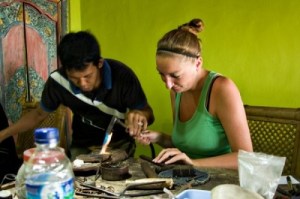
As you enter the neighborhood, you’re going to feel as if you were in a jewelry exhibition. On ether side of the road are established many art shops showcasing their finest works inside a glass display case. You can take a closer look at them to appreciate it and buy some if you really like it. Most vendors and smiths usually accept custom made jewelries but you can always ask them to make sure. Most of them are used to dealing with foreign tourists so their English should be fair enough to promote a conversation.If you’re confident enough, you may ask their permission to forge and shape your own jewelries. Some of them might allow you, even guide you how to use the tools properly. Be careful, though, because molding silvers and golds involves fire and fire can burn your fingers pretty badly, not to say your money as well.
Seminyak to Mas Village Ubud is take us about 1 Hour and 30 minutes drive, Mas Village is one of villages in Bali fundamentally identified as an artistic countryside by focusing in artistic of wood carving. Mas Village is located in Ubud, become tourist destination to visit for wood carving art
Is one of villages in Bali fundamentally identified as an artistic countryside by focusing in artistic of wood carving. Mas Village is located in Ubud sub district and Gianyar Regency, east part of Bali. It owns the typical style of wood carving art by placing forward the distinguish synergy the humanism and naturalism. The village’s popularity as an wood carving art village is famous in the national and world level which is not forgetting from the highness name of some maestros which has borne and found the spirit (taksu) and soul. The famous wood carvers here are the late Ida Bagus Nyana and son Ida Bagus Tilem. Along the road we can find a lot of art shops that sell many kind of wood carvings. On the left or on the right of the road we can also see rice field, so we can make conclusion that the live of Mas people not only as wood carvers but also as farmers. A lot of visitors come to this village every day, they want to see or to bau wood carvings and to see the people there, how to make wood carvings.
Mas Village is Place to visit in Bali
This Artistic countryside owns the long history root. The result of wood carving art in this village owns the immeasurable and wide dimension like idol for the devoting (arca idol), representative dimension of everyday Balinese social society life (farmer, fisherman, worker, intellectual, merchant etc), the abstract dimension as existing of actor imagination which is listening carefully of reality, dynamics and life philosophy. The villagers are same as villagers at other tourism countryside in Bali that have also experienced the transformation from agrarian society to the crafting society. Even nowadays, it is continued to service society from commerce service until levying service of the souvenir for overseas and domestic tourist.
Location Mas Village :
Mas Village strategically located in the main road from Denpasar to Ubud and it can be reached from various of angle. It is about 15 km easterly go to the majors road to Ubud from Denpasar town. If you wish to go to this place from Denpasar, the starting spandrel points step into Mas Village is Sakah, where a big baby idol monumentally existing in the middle of road. The Baby idol is a symbol and representative of human being life early which is believed by local residents with full of philosophic value, religious and dynamism.
Seminyak to Bukit jambul is take us about 2 hours drive and The name of Bukit Jambul Rice Terrace was firstly given during the Dutch invasion in Indonesia by a tourist, who was inspired by a high hill standing on the south, is great place to visit after visiting besakih temple.
the name of Bukit Jambul was given during the Dutch invasion in Indonesia by a tourist, who was inspired by a high hill standing on the south of the main road connecting Klungkung regency and Besakih of Karangasem regency. There is a Hindu Temple called Pura Pucak Sari on the top of the hill, which is surrounded by big trees. Below the temple complex there is a stunning panorama of rice fields. This makes the trees look like a tufting hair from a distance
Bukit Jambul Rice Terrace is renown as an outstanding natural tourist destination due to the harmonious combination of hilly land, rice fields, valleys and the beautiful sea panorama in a distance. From high land, we will be able to witness the beauty of the nature beneath. hill where there is a large banyan tree growing on the top of hill like crest so that the local people give it name asBukit Jambul Rice Terrace where Bukit is means hill, meanwhile Jambul is means crest. This place become famous because it was inspired by the most amazing scenery with rice terrace, winding road underneath and palm trees stretching to the sea. It is situated in the plateau area that is always covered by cool temperatures that make it as an
Bukit Jambul Rice Terrace is Tourist Destination in East Bali
Bukit Jambul Rice Terrace is one of the nature tourist destinations that very interesting to visit in Karangasem Regency that is located 1,5 km from Denpasar City. Now, this place is very famous and it was a stop point on Besakih Temple Tour Programs. This place is also supported by the existing of local restaurants offering best selection of Indonesian and international menus for tourists who visit it. The tourist will be pampered by the beautiful scenery with amazing panorama including the fresh tropical atmosphere sweep the entire area.
Location Bukit Jambul Rice Terrace :
Bukit Jambul Rice Terrace is located at Pesaban traditional village, Nongan village, Rendang district. It is approximately 8 kms from Klungkung regency to the north, and about 51 kms from Denpasar or 15 kms from Besakih. Take about 1,5 hours drive away using vehicles or 30 minutes to Besakih Temple that is famous called by Mother Temple. When we take the direction from Kerta Gosa, we just take 30 minutes away to the north side until we found the windy road. So, this place is very easy to be located because it is located in the strategic location just beside of the main road from Klungkung to Besakih Temple.
Facility at Bukit Jambul Rice Terrace :
This area is facilitated with food stalls or “warung” and also small restaurants, with a quite large parking lot.
Seminyak to Pupuan Rice Terrace is take us about 2 hours drive its beautiful rice terrace located in the western part of Bali, a place to fill your eyes with awesome memories of great landscape accompanied by no one other than the friendly local farmers
Seminyak to Pupuan rice terrace is will one of the great journey , is beautiful rice terrace located in the western part of Bali, a place to fill your eyes with awesome memories of great landscape accompanied by no one other than the friendly local farmers. Pupuan Rice Terrace is best enjoyed early in the morning or late in the afternoon on a clear day. When rainy, fog usually follows the rain and obscures the whole village. With the arrival of the planting season, the local cultivators start plowing their fields adding traditional culture to the scenery.
The cultivators have retained their old way of cultivating their land with the help of buffalo. As padi grows profusely in the area, a deep green covers the landscape, resembling a vast emerald rug laid on the slopes of the hills. The cultivators of these crops share an intimate relationship with nature. At harvest time, the cultivators cut the paddy with traditional equipment called anggapan. Standing in rows, they sing while they glean their harvest.
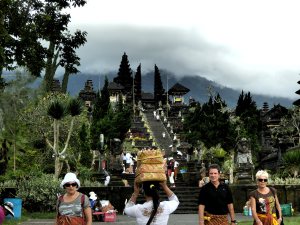
Seminyak to Besakih Temple is take us about 2 hour drive and it is the biggest Hindu temple in Bali which the local people call Pura Besakih. It owns beautiful view from the top of temple area where we can see the wide nature panorama until to the ocean, the ticket in Besakih temple is 20.000 IDR
Besakih Temple is the biggest Hindu temple in Bali which the local people call Pura Besakih. It owns beautiful view from the top of temple area where we can see the wide nature panorama until to the ocean so that way this temple is many visited by tourists from all over the world. Besakih Temple is located in Besakih countryside, Rendang sub district, Karangasem regency, east part of the island. It is located in southwest side bevel of mount Agung, the biggest mounts in Bali. It is because pursuant to Agung Mount confidence is holiest and highest mount in Bali Island.
Bali’s “mother temple”,Besakih temple, is over 900 metres up the slopes of Gunung Agung. It has been regarded as a holy place since pre-historic times in Bali. The first recorded mention of its existence is from an inscription that dates from 1007 A.D. Since the Gelgel dynasty of the fifteenth century it has been regarded as a central, holy temple for the entire island.
All the allegiances of the Balinese people come together at Besakih. Each regency has its own temple within the over-all compound, as do each of the caste groups. There is a total of 18 separate sanctuaries. The three main temples are : Pura Penataran Agung, Dedicated to Sang Hyang Widi Wasa : Pura Kiduling Kreteg, dedicated to Brahma; and Pura Batu Madeg, dedicated to Wisnu. To the Balinese a visit to the temple sanctuaries at Besakih temple is a special pilgrimage. Each temple has its own odalan, or anniversary celebration, and on the full moon of the Balinese month “Kedasa” the entire compound of Besakih celebrates the visit of the gods, with an enormous throng of visiting pilgrims.
The Besakih’s name is come from the word of Basuki,the old language from Sanskrit Wasuki, and then it become the Ancient Java Language. In this Sanskrit, the Basuki means congratulation. In mythology of Samudramanthana has mentioned that Basuki is a dragon that twines the Mount Mandara. The omission has come from tradition megalithic which had been indicated that it had to be sanctified place. It seems, the Besakih temple is coming from very old era which is far before the existence of Hinduism influence. Hereinafter, an Ancient Bali king of Sri Kesari Warmadewa found the Merajan Selonding Temple in this temple complex area. He also commands to build the Blanjong Monument that is located in Sanur Village. The Besakih Temple complex is built pursuant to cosmos balance. It is based on the nature conception which is disseminating the fundamental temple complex that is arranged to pursuant of the way direction. So, this building can deputize nature as symbolic of the world balance existence.
As we familiarize, that the point direction way like East, South, West, North, and middle as center point and each direction is named by Mandala. In Hindu philosophy, Panca Dewata is manifestation of Siwa God. Like Penataran Agung Temple as center, we find in its courtyard conception show the solidarity conception between the original Indonesia culture namely tradition megalithic in form of Punden Berundak-undak with the Hinduism concept. The ancient omissions which is existing in Besakih Temple complex can be classified into 2 types those are omission pertained by megalithic tradition and classic era. Besakih Temple beside as the altar for Hindu people in Bali, it is also as tourist destination which is a lot of visited by tourists.
Seminyak to GWK or Garuda Wisnu Kencana (GWK) Bali is located in the southern Badung area. is an area with 240 hectares of land. There are Supporting facilities that you can enjoy like Lotus Pond, Festival Park, Amphitheater is take us about 1 Hour to get here from seminyak and also the ticket is 100.000 IDR per person to visiting Garuda Wisnu Kencana Cultural Park
Seminyak to GWK is tak us about 1 Hour drive and is located in the southern Badung area about 20 minutes from Kuta. That’s very easy to access it from the Ngurah Rai Airport and hotels in Nusa Dua. Garuda Wisnu Kencana (GWK) Bali cultural park is located in the hills of limestone and rock, exactly over the hill of Nusa Dua Pecatu-Badung regency that about 40 kilometers south of Denpasar City Bali, it was approximately 30 minutes drive from Ngurah Rai when using a motor vehicle.
Landscapes Garuda Wisnu Kencana
Bali Garuda Wisnu Kencana Cultural Park is an area with 240 hectares of land. There are Supporting facilities that you can enjoy like Lotus Pond, Festival Park, Amphitheater, Street Theater, Exhibition Hall, and Jendela Bali The Panoramic Resto and souvenir shop as well. There are many cultural performances every day at GWK. Barong Dance Performance is the most popular show in there and also performances of traditional Balinese music. Various uniqueness and beauty of Bali are well in view of the history, traditions, cultural customs, arts and panorama attraction. Of many attractions in Bali one of them is Garuda Wisnu Kencana that abbreviated. Garuda Wisnu Kencana (GWK) Bali cultural park is the window of island arts and culture against the backdrop of nature and an amazing panorama, making one of the main objectives for a variety of performing arts, exhibitions, conferences or religious visits.
Story of Garuda Wisnu Kencana
Here is the story of Garuda Wisnu Kencana which follow the birth and deeds of the mythical bird Garudaas quoted from Wikipedia. You can find this story carved into stone relief, placed in GWK Street Theater.
The story of Garuda birth and deeds is told in the first book of the great epic Mahabharata. According to the epic, when Garuda first burst forth from his egg, he appeared as a raging inferno equal to the cosmic conflagration that consumes the world at the end of every age. Frightened, the gods begged him for mercy. Garuda, hearing their plea, reduced himself in size and energy. Garuda’s father was the creator-rishi Kasyapa. His mother was Vinata, whose sister was Kadru, the mother of serpents. One day, Vinata entered into and lost a foolish bet, as a result of which she became enslaved to her sister. Mahabharata mentions about a bet between sisters and wives of Kashyapa, Vinata and Kadru, about the colour of Uchchaihshravas‘s tail. While Vinata, the mother of Garuda and Aruna, said it was white, Kadru said it was black. The loser would have to serve as a servant of the winner. Kadru told her sons, Naga (“serpent”), to cover the tail of the horse and thus make it appear as black in colour and thus, Kadru won. Resolving to release his mother from this state of bondage, Garuda approached the serpents and asked them what it would take to purchase her freedom. Their reply was that Garuda would have to bring them the elixir of immortality, also called amrita. It was a tall order. The amrita at that time found itself in the possession of the gods, who guarded it jealously, since it was the source of their immortality. They had ringed the elixir with a massive fire that covered the sky. They had blocked the way to the elixir with a fierce mechanical contraption of sharp rotating blades. And finally, they had stationed two gigantic poisonous snakes next to the elixir as deadly guardians. Undaunted, Garuda hastened toward the abode of the gods intent on robbing them of their treasure. Knowing of his design, the gods met him in full battle-array. Garuda, however, defeated the entire host and scattered them in all directions. Taking the water of many rivers into his mouth, he extinguished the protective fire the gods had thrown up. Reducing his size, he crept past the rotating blades of their murderous machine. And finally, he mangled the two gigantic serpents they had posted as guards. Taking the elixir into his mouth without swallowing it, he launched again into the air and headed toward the eagerly waiting serpents.
En route, he encountered Vishnu. Rather than fight, the two exchanged promises. Vishnu promised Garuda the gift of immortality even without drinking from the elixir, and Garuda promised to become Vishnu’s mount.
Flying onward, he met Indra the god of the sky. Another exchange of promises occurred. Garuda promised that once he had delivered the elixir, thus fulfilling the request of the serpents, he would make it possible for Indra to regain possession of the elixir and to take it back to the gods. Indra in turn promised Garuda the serpents as food. At long last, Garuda alighted in front of the waiting serpents. Placing the elixir on the grass, and thereby liberating his mother Vinata from her servitude, he urged the serpents to perform their religious ablutions before consuming it. As they hurried off to do so, Indra swooped in to make off with the elixir.
From that day onward, Garuda was the ally of the gods and the trusty mount of Vishnu, as well as the implacable enemy of snakes, upon whom he preyed at every opportunity.
This area is the first real rock and steep sloping then transformed into the beautiful and amazing with charming architecture. Implementation of the process by means Bukit cut into giant pillars like building in Egypt but still with the feel of Bali. From the Garuda Wisnu Kencana (GWK) Bali, we can see how beautiful Kuta Beach, Jimbaran, Bali’s Ngurah Rai Airport and the Port of Benoa.
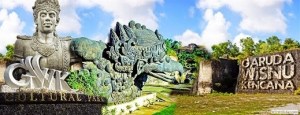
The area of Garuda Wisnu Kencana (GWK) Bali Cultural Park planned to be established a landmark or Bali mascot, in the form of a giant statue, that is a statue of Lord Vishnu riding a Garuda bird. This statue was projected to tie layout with visibility up to 20 km so that it can be seen from Kuta and Nusa Dua.
Garuda Wisnu Kencana Statue is a symbol of the mission of saving the environment and the world. The statue was made from a mixture of copper and steel weighing 4,000 tons with a height of 75 meters and a width of 60 meters, which was created by sculptor Bali, I Nyoman Nuarta, if manufacturing is complete, can match the Statue of Liberty in United States.
Garuda Wisnu Kencana (GWK) Bali Facilities :
Lotus Pond surrounded by stone pillars and rock background Garuda bird statue’s head with a capacity of 7500 people made the area is ideal for a variety of grand performances, both national / international.
Plaza Wisnu art shop selling various Balinese handicrafts.
Exhibition Hall space to hold exhibitions.
Amphitheatre with a capacity of 800 seats and first-class acoustic arrangement is performance art.
Street Theatre is an outdoor stage for music concerts, fashion shows and other performances.
“Jendela Bali” Restaurant with panoramic of Jimbaran Beach.
When entering Garuda Wisnu Kencana (GWK) Bali area you will be encountered several pieces of natural rock pillars wich high 25 feet are standing firm. Not far from Lord Vishnu statue, there is a sacred spring called Parahyangan Somaka Giri, why say sacred, because the water is coming out of the barren limestone hills. The water is believed to cure various diseases, also used as requirements to summon rain.
Seminyak to Jatiluwih will take us about 2 hours drive is a name of country side located in the plateau area with the mountain as a backdrop. It owns very beautiful panorama of rice terrace unfolding from the foot of mountain to the sea. Is popular tourist destination and the ticket visiting the jatiluwih is 40.000 IDR per person
is a favorite tourist destination in Bali famous with the beautiful rice terrace unfolding from the foot of mountain until the coastal side. It is one of places to visit in Bali with the beautiful view as according to its name from Jati and luwih, where Jati mean really and Luwih meaning especial, good, and beautiful or the equivalent. The local paddies are planted in this place look typically of the high relative size plant if it is compared with other pre-eminent paddy planted by most farmers in Bali . Despitefully, Jatiluwih also famous with its organic agriculture system due to the location is located in the in the plateau of Watukaru Mount which is suitable for the agriculture development. The Ticket or entrance fee in Jatiluwih is 40.000 IDR per person
Jatiluwih is one of the place of interest in the area of Penebel, Tabanan. Jatiluwih famous for its natural beauty with terraced rice fields which neatly. in this place also in the beautiful mountain scenery named Batukaru mountain, because the location of this Jatiluwih right at the foot of the Batukaru mountain.
Jatiluwih rice cultivation has an area of approximately 636 ha. And this Jatiluwih rice field located at an altitude of 700 meters above sea level. This area is a suitable place to visit for the one who missed the Mountain fresh air and the natural panorama as a place to soothe the mind, because of the beautiful place that is still natural with fresh air.
Jatiluwih is surrounded by cool atmosphere because it is located in the height of 700 meters above sea level. Besides its nature potency, Jatiluwih is also saving the cultural potency, especially history of the Petali Temple existence that is related to the power of Ida Dalem Waturenggong King in Keraton Gelgel (1460 – 1552). The distance from Denpasar to Jatiluwih is about 48 km and it is situated in upstate of Tabanan town (28 Km). The road to this place has been progressively improved so that motor vehicle can enter from east side through Pacung Village and go to Jatiluwih and also from the west side from Watukaru Temple pass to Jatiluwih. Jatiluwih is many visited by tourist from local and foreign countries who want to enjoy the cold atmosphere and beautiful panorama of rice terrace. Jatiluwih as a nature tourist destination in Bali which has been recognized since Dutch colonial build the Security Headquarter and until now the local residents conceives with the Dutch Tangs. Indonesian government has assigned the Jatiluwih to be a Tourist Destination Village because of this potency.
Jatiluwih also keep the unique religious ceremony attraction which is famous know as Patirtaan in Petali Temple on Wednesday Kliwon Ugu (Based on Balinese Calendar). The local residents believe that Petali Temple is a worship center of The Hyang Widhi Wasa (the God) as agriculture power. Beside of Petali Temple , there is also Pucak Rsi Temple is located in this area. As a tourist object, Jatiluwih provides the public facilities like parking area, toilet, resting bale and Wantilan for tourist who is enjoying the beautiful panorama. Some restaurants have been built to serve the food and beverage.
From Jatiluwih Rice Terrace tourists can also visit the hot spring water of angsri,because the distance from the hot spring angsri Jatiluwih so is close. Although the location of this resort is very isolated, with roads winding,but many area attractions that we can enjoy there. For the journey to this region also is not boring,because we travel along the beautiful river views along the way in which vast stretches of rice field,and the shady trees that lined all the way to Jatiluwih.If you want to visit tourist areas filled with green rice fields stretching to the beauty and it’s tradition so Jatiluwih are the areas you should visit, I am sure that you’ll feel amazed at the scenery in front of you. All well presented by Seminyak Bali Driver the best transportation services In Seminyak Bali
Seminyak to Gunung Kawi Temple located in Tampaksiring is bout 2 hours drive, this collection of candi is beautifully situated in a river valley surrounded by rice fields and jungle. Is great place to visit and enjoy the beauty of the collection candi. The ticket is 20.000 idr per person
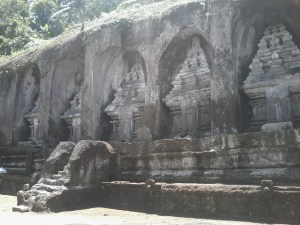
Bali’s own Valley of the Kings is Gunung Kawi Temple in Tampaksiring. This collection of candi is beautifully situated in a river valley surrounded by rice fields and jungle. This has been one of our favorite day trips for years. Gunung Kawi Temple is a collection of ten candi, created to evoke the appearance of temple fronts and designed to provide residence for the souls of ancient kings. The candi are hewn into the valley walls on both sides of the Pekerisan River. The Gunung Kawi Temple does have an interesting history. Inscriptions over each Candi approximate the date of construction to be in the 11th C. It is believed that each temple served as a memorial to a deified royalty principally because they are shaped like the burial towers, or Candi’s, found throughout Central Java. But in Java they are free standing whilst those found at Gunung Kawi are actually hewn relief’s in solid rock. While the exact origin of the candi is unknown, there is evidence to suggest that the first set of five were built to honor King Anak Wungsu, whose rule over central and east Bali extended from AD 1050 to about AD 1080. It is possible that one was built for him and the other four for his wives, who would have ceremonially committed suicide after his death
Gunung Kawi Temple is two rows of ancient royal tombs on the banks of the Pakerisan River deep in a ravine overlooked by terraced rice-fields. The holy Pakersian River flows through the centre of Gunung Kawi cutting the site into two separate sections with a bridge to connect one side to the other. It is believed the holy waters of the Pakerisan sanctify Gunung Kawi, and the beauty of the place evokes a relaxing and peaceful atmosphere.
On the east side of the river are situated five candi which constitute the main group in this complex. Across the bridge are four candi on the west side. The remaining candi at the southern end is often referred to as the ‘tenth tomb’. At the bottom of the stairway and to your right-hand side through a small field (about one kilometer) is where the tenth tomb is located. The legend to this amazing place is intriguing. It is believed that the mythical giant Kebo Iwo carved out all of the ancient tombs in one night with his fingernails. There are 3 temples which so called the name as Gunung Kawi in Bali those are Gunung Kawi in Sebatu countryside, Gunung Kawi Temple in Keliki countryside and Gunung Kawi Temple in Babitra countryside. Behind the small temple you can find a couple of meditation caves, which indicates that this is a pre-Hindu place where monks and pilgrims came together to meditate.
Gunung Kawi Temple Location
Gunung Kawi Temple is located near Tampak Siring village, around 5 km from well known Tirta Empul Temple. The location is 35 km from Denpasar, city, 50 km from Kuta, and 68 km from Nusa Dua. It is still one route from Goa Gajah, Pura Pusering Jagat, Gunung Kawi Temple, and Tirta Empul Temple . This area preserves many ancient sites, stone sculptures and rock cut structures, especially along the slope of Pakerisan river. The site of Gunung Kawi Temple is reachable only by foot from the parking area, passing elevating slope of the river with more then 100 steps down and up the river. It is just after the village of Pejeng, a village full with ancient remains of ancient stone sculptures, and even the oldest historical fact on Buddhism is found also around this village. Today due to the rich contains in historical fact a museum has been built before the village of Pejeng, near the temple of Kebo Edan. Within the village of Pejeng to mention a few of them there are some temples with ancient heritages such as Pura Pusering Jagat, Pura Rejuna Metapa, Pura Kebo Edan, Pura Samuan Tiga, Pura Bedugul Kana, and still many other smaller temples that preserves the ancient stone sculptures. Pejeng is a real historical museum.
Gunung Kawi Historical Monument
If we see from the name we know today, it might be the possibility of translation Mountain as a Gunung and Kawi as poet, so gunung Kawi can be meant the mountain of poet. The river that forms the ravine which slope is cut for the temple is Pakerisan river, kris means Balinese long blade or knife. What is actually referred by the name is not clear until now. The people today consider this complex as part of a temple which was constructed much later time. See from the history it is not part of a temple in the meaning of worshipping the Hindu God, but having the relation with personal deification of a king. The whole complex consist of 5 smaller complexes, and including the temple are 6 complexes. Two complexes at the east slope of the river and 3 complexes are on the west slope. Two complexes facing each other separated by the river are identified as belong to the king and his Queen or concubines. The complex for the king consist of 3 rock cut candis and the complex for the Queen consist of 4 rock cut candis. It is hard to understand that only the candi for the king made in 3. It might be the king was with his 2 principal consorts, and the 4 candis across the river were only for his other concubines. At the door of the candi for the king is mentioned in a inscription of the king died at Jalu. Jalu can mean kris or taji, a sharp small blade armed for the cock fighting. Who was the king monumentalized here? is un-answered question until now, except based on highly decorative writing of inscription called “Quadrangular Kadiri writing style” The influence of Kadiri kingdom to Bali was only arrived around 1227 AD under the king Kertanegara. While the date carved at the stone sculpture on Mount Panulisan with the same style mentioned the dates 1011 AD, 1074 AD, and 1077 AD. While the period between 989 AD to 1001 AD was the rule of king Udayana Warmadewa with his Queen Mahendradatta. In their charters it is mentioned that king Udayana was deified at “Banyu Wka”, and his Queen Mahendradatta was deified at Buruan which is already identified, and only Banyu Wka is not identifiable until today, and archaeologists supposed that Banyu Wka is Gunung Kawi, as Banyu means water, and Wka means clear or clean, so he must have been deified at a river with very clean water, yet an ancient monument just renovated is Pura Mangening which also refers the name of ening or clear. The problem is the complex of the temple is not big, only one stone shrines with small zone. If we compared with his Queen monument in Buruan it makes sense that the king would not need big complex to commemorate himself. So who was monumentalized at Gunung Kawi? Some archaeologists believed that was the son of Udayana, either king Marakata Pangkajasthana or Anak Wungsu. The rule of Marakata is not known much and there is not many record about his government. Different from Anak Wungsu who issued many inscriptions and he was a diligent king in making every records which lead an idea that he was a great king just like his father king Udayana. With the length of time of ruling that was from 1049 AD to 1077 AD can be a proof that during his rule the condition of the society was good, and it was not impossible he was respected by their whole people. As the fact of many great king in Indonesia that commemoration with candi or sculpture was a normal way the people to honor their king who was able to bring the welfare for the society. In this case writer wish to believe that Gunung Kawi Temple has been dedicated for the great name of king Anak Wungsu.
Seminyak to Rambut Siwi Temple is taking about 3 hours drive and is depending the traffic because west of Balli is has only one main road with lots of big truck also passing around to Java next island is one of the biggest Hindu Temples in Bali and become best tourist desintination to visit in west part of Bali. Is own with a relic of sage hair. It is a beautiful Hindu shrine set in the cliff bank. The ticket on Rambut Siwi is 20.000 IDR per person
Rambut Siwi Temple is located in Jembrana regency, east of Yeh Embang village, Mendoyo district. It is about 10 km from Negara and can reach by any cars or motorcycles as well. Local peoples believe that they have to worshipped this temple to get a God bless of securing during the Journey. The Main temple located in cliff bank and and blessed by the breath taking view of the Indian ocean. This temples owns the representative temple building which is set beside main road of Denpasar to Gilimanuk. Name of Rambut Siwi is contain of a relic which is a lock of sage’s hair (rambut) that is venerated (siwi).
History of Rambut Siwi temple itself, it is about when Danghyang Niratha frist arrived from Java from traveling to the west, on his way to present himself to King of Gelgel, he heard a terible epidemic in Gading Wani village, Danghyang Nirata went there and heal the disease. The grateful villager s begged him to stay and settle there but Danghyang Niratha remember that he have to present himself to Gelgel, and he left them a lock of his hair as a protective token. And since that Danghyang Niratha was given the honorific name “Pedanda sakti Wawu Rawuh” means “The newly arrived powerful high priest”
The Rambut Siwi Temple is one of the biggest of all the Hindu temples in Bali and is located in the Negara regency in the west of Bali. Situated about 2 hours away from Denpasar in the further western areas where the atmosphere is classically Balinese with un-spoilt tropical woodlands and small villages spread out around the coast with a few larger areas inland. Most of this area is the conservational park of Bali which is home to many of the island\’s endemic species that are now protected in the hope of re-sustaining the entire island. Located right the beach the Rambut Siwi Temple is very photogenic and is extremely beautiful with the main shrine set in to the cliff. As with many of the Balinese temples, the recorded history of the Rambut Siwi Temple is unsure and sparse although the locals maintain that the temple is one of the water temples was built in order to keep the powerful forces of the sea away from the land and the village. Rambut Siwi Temple is the location of many ceremonies and activities in the Balinese Hindu calendar and the family calendars of the local families such as birth and marriage ceremonies.
The locals also believe that the Rambut Siwi Temple is a secret temple, today it is difficult to spot and it is said that there was a time when the temple was secret and held many secret objects and is shrouded with mystery and uncertainty to this day. this certainly adds to the charm of the Rambut Siwi Temple and is one of the reasons that its tucked away and yet grand statue is so impressive and yet humble. Another use of this temple is for the blessing of the journey that is made when traveling in these parts as often the passing of the Rambut Siwi Temple is on a long journey. There are other temples that are used in similar ways but many locals can be seen stopping at the Rambut Siwi Temple for a short time in order to ensure that their journey will be safe one heading either further north or back to the south of Bali. The views in this are sensational ether looking towards the sea and down over the temple or from the beach looking up to the temple and over the tropical woodland that surrounds it.
The gardens include extremely well kept tropical flowers and trees presented in classic Traditional Balinese styles and maintained with a great amount of care. Visiting the Rambut Siwi Temple is cheap and a very beautiful way to spend part of your day in this area, particularly at sunset when it is at its most beautiful. The Rambut Siwi Temple is a far less crowded alternative to the Tanah Lot temple that is the most visited temple in Bali and the most Photographed of all the places in Bali. However you have to be willing to make the longer journey to enjoy the Rambut Siwi Temple\’s serenity.
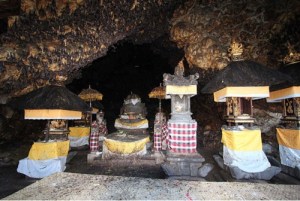
Seminyak to Goa Lawah or Bat Cave Temple is taking about 2 hours drive and is a shrine cave where thousands of bats have a nest inside of this cave. There is big temple used by Balinese Hindu as a place to worship to the god. Best tourist destination to visit in eastern Bali, The ticket to visit the Goa Lawah Temple is 20.000 IDR per person
Goa Lawah is one of favorite places of interest in Bali and it is located near of hilly bank so it is called reef of Middle hill. This cave is located in Pasinggahan countryside, Dawan sub district, Klungkung Regency, east part of Bali and about 1,5 hours from Denpasar Town. There is a nature cave dwelt by thousands of tail bat located at north side from Jeroan/center of Gua Lawah Temple . Meanwhile the main road from Klungkung to Amlapura is just in front of the temple. This cave is apposite to the beautiful beach with black sand along the coastal area.
Goa Lawah Temple, a shrine for Balinese Hindu
Pursuant to the papyrus of Dwi Jendra Tattwa, the Goa Lawah’s name is Goa Lelawah, the name which is given by Danghyang Nirartha (a priest overspread the Hindu teaching in Bali) when he stop in this place on his Tirtha Yatra trips. He arrive at a cave which is a lot of bats hang on and its unbroken voice clamor as hymn to add the beauty of the cave. Therefore this cave is named by Goa Lawah or Bat Cave. On the above cave is growth by the flower trees with it’s smelt fragrance and stimulus the peace mind of Danghyang Nirartha, so that he overnight stay for some nights in this place. From the cave we see also the beautiful coast with the blue ocean with Nusa Penida Island as a backdrop.
Goa Lawah Temple History
According to the chronicle of Bendesa Mas, it mentions that the elaborations of Mpu Kuturan (a Hindu priest who come from Java) then he live in Bali which has been hosted in Silayukti, Padang Bai. He also builds some temple like Gua Lawah Temple
According to the Papyrus of Dwijendra Tattwa, it narrates that after Danghyang Nirartha stay some nights at Goa Lawah, then he build a Kahyangan Temple on the ground. It means that Danghyang Nirartha extends the Palinggih or temple building existing at Gua Lawah Temple .
Bali tourist attraction is a cave located on the beach called Beach Kusamba, at the mouth of the cave there is a temple named Pura Goa Lawah (Goa Lawah Temple).
Goa Lawah very interesting to visit because of strategic location off the coast with views of sea and island of Nusa Penida in the distance and the arrangement of beautiful beaches. On the beach sometimes tourists can witness traditional ceremonies and activities can also see bats hanging from the edge of the cave. Bali tourist attraction makes this one worth your visit with your family during the holidays to Bali
Location : Goa Lawah Klungkung located in approximately 1 hour drive from Denpasar City or 4 miles from the center of Semarapura which is the district capital Klungkung.
History : In Goa Lawah consists of two syllables of the cave, which means cave and Lawah which means bat cave where Lawah tail inhabited by thousands of bats in the mouth of this Bali attractions there is a temple Khayangan Jagat status. Goa Lawah Temple is a sacred and beautiful area. There was a blend of sea and mountains (linga-yoni). As the name suggests, this temple there is a cave inhabited by thousands of bats. While at the mouth of the cave there are several palinggih Stana of the Gods. In the yard, also stood firm several Meru and other sthana. Narrated MPU Kuturan come to Bali during the tenth century the government-led Children’s Youngest brother of King Airlangga. Airlangga own rule in East Java (1019-1042). When he arrived, mpu Kuturan find many sects in Bali. Seeing the fact that, mpu Kuturan then develop the concept of Tri Murti with the aim of uniting all these sects Kuturan MPU also teaches making heaven Pakraman Three in every village in Bali as well as confirmed the presence of Jagat heaven that one of them is Goa Lawah Temple




 Seminyak Tour Driver Bali - Authorized and Registered at Royal Bali Tourism Industry