Bali Driver, Bali Driver Seminyak, Sunset Road Bali, Seminyak Activities, Seminyak Driver, Seminyak road, Seminyak Taxi, seminyak tour, Seminyak Tours, Seminyak Transport, thing's to do in seminyak

Seminyak to Git Git Waterfall


gigit_waterfall
gigit waterfall

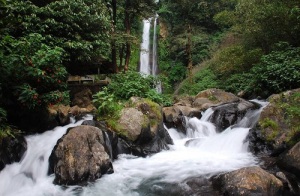
Seminyak to Git Git Waterfall is taking about 2 hours and 30 minutes is an amazing waterfall from height hill which is encircled by fertile rain forest plantation. Situated in the jungle of forest, fresh atmosphere with beautiful panorama and popular tourist destination for waterfall visit. The ticket visiting the Git Git waterfall is 20.000 IDR Per person

Git Git waterfall is a beautiful tourist destination in north part of Bali. Gitgit waterfall is located in the plateau area with the height about 35 meters and it is surrounded by tropical tree and emits the constantly natural water debit during the year. Waterfall voice around the charming nature was amazing and it was the separate attraction which can be enjoyed by each visitor who comes to visit. There are some plantations protecting the rain forest around the waterfall and in this place we often met the wild monkey to get the water from this waterfall.


Tourist Destination in North Part of Bali

Gitgit Waterfall is one of the famous tourist destinations in Bali which is located in Gitgit countryside, Sukasada sub district and about 10 Km from Singaraja Town or about 70 Km from Denpasar. It is set at height land about 300 meters above sea level. Beside of Gitgit, there is another important spot point like the monument for hero struggle of Singaraja resident who dead on the battle against the Dutch colonialist. This monument is called Bhuwana Pangkung Bangka. This Monument is extant monument and idol of people struggle action against the Dutch colonization. This monument is located in Gitgit countryside and Sukasada sub district and about 17 Km from Singaraja Town .

It is situated on the hill bank. The facilities are available at Gitgit Waterfall is consisted of the parking area, restaurant and art shop. It is not far from the waterfall place, there is a place for taking a rest while enjoy the beauty panorama of rice terrace and Buleleng Beach. In order to visit the Gitgit waterfall, all visitors will follow the walkway down until the spot point. This road is one of the omissions in Dutch era where the local resident uses it to access other regions. On 1975, this waterfall is opened as tourist destinations in north part of Bali . Since it is appointed as a tourist destination in Bali, many tourists from domestic and foreign countries visits this waterfall and Bali North Tour is one of the famous tours in Bali visit this place.


The Gitgit Waterfall

This is the most famous waterfall in Bali.  The Gitgit Waterfall is on the edge of the Highway Denpasar – Bedugul – Singaraja .The Waterfall is 300 meters above sea level and often visited by tourists, it can get very busy. The Gitgit Waterfall is located in the village Gitgit, Sukasada District, Buleleng regency. Waterfall Gitgit is located between villages and clove plantations. All 3 series of cascades are on the same watershed. They have separate parking spots, all close together. Roads and stairs are well maintained, making it easier to visit.  On the side of the road that passes the waterfall, there are several souvenir shops. Along the way you also see many small children who try to sell beads. You will also find a lot of guides trying to show you the way!

The Gitgit waterfall consists of several waterfalls with different shapes and heights. Halfway along the way the scene changes and on both sides you can see coffee and clove trees. It is a refreshing experience to walk in this quiet area where the birds take turns to sing. The air is cool and gradually gets colder when you approach the waterfall. A short distance from the waterfall, the fine water spray will cool your body. Sometimes the atmosphere will become misty.

  • The first Waterfall in Git Git Waterfall

is Twin Falls you have to go down a path and stairs to get there.Twin Falls as the name suggests, consists of two adjoining waterfalls. Both waterfalls are not very high but the current is quite swift. Below the waterfall there is a small pond with very clear and cold water. This waterfall is sheltered in a narrow cliff so it is a bit dark. Green trees that surround the waterfall make the atmosphere cool and beautiful.

  • The second Waterfall in Git Git Waterfal

is a continuation of the Twin Falls. The source water comes from Twin Falls watershed. The second waterfall is a bit higher than Twin Falls, it is sixty metres high and as the water falls, it looks like white clouds falling down the mountain one after another. The falling water almost completely covers the rock face of the fall.

  • The third Waterfall in Gitgit Waterfall

is called Waterfall Story. You can only see this waterfall from the bridge it is not so high but quite beautiful. The water is very clean and clear. This Waterfall is located under the bridge and covered by trees. You cannot see this waterfall from the front.

There are beautiful waterfalls in Bali that deserve your visit. Some are easy to reach, others are more challenging. Most waterfalls are in the mountains in North Bali
Bali Driver, Bali Driver Seminyak, Sunset Road Bali, bali tour, Seminyak Activities, Seminyak Driver, Seminyak road, Seminyak Taxi, seminyak tour, Seminyak Tours, Seminyak Transport, thing's to do in seminyak, tirta gangga

Seminyak to Tirta Gangga Water Palace


Tirta_Gangga_Bali
Tirta Gangga water temple in east Of bali

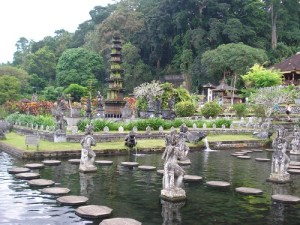
Seminyak to Tirta Gangga will take about 2 hours drive Tirta Gangga is a beautiful Water Palace with water fountain and fish pond surrounds this area. This garden is built by King of Karangasem for their relaxation with their family. Become one of places of interest worth to visit in east Bali. The Ticket will cost us about 20.000 IDR per person to visiting this attraction

it’s one of the famous tourist destinations in east part of Bali and it is one the stop points of tourist object on East Bali Tour Itinerary. In the middle of park, there are many small statues are intentionally set on the stone to decorate the park in order to make a good looking. All of the statues are taken from the Hindu Historical epos like Maha Bharata or Ramayana. On this page, we present the statue photo at Tirta Gangga Park.

History of Tirta Gangga Park :

Tirta gangga built in 1948 by King of karangasem, Anak Agung Anglurah Ketut Karangasem. This water park is constructed in a very unique architectural style of Bali and China.

Location of Tirta Gangga Park :

Tirta gangga located at Abang Sub-district, Karangasem Regency in east part of Bali, about 83 km from Denpasar and 6 km from Amlapura to the north.

Facilities of Tirta Gangga Park :

Facilities available in this area such as small hotels, small restaurants, and shops and extensive parking area.

Description of Tirta Gangga Park :

Tirta gangga places in 1.2 hectares in area which consists of three complexes. The first complex that is at the very bottom to find two teratati ponds and fountains. The second complex is the center where it can be found in a swimming pool, while, on the third part, namely the third

Complex of Tirta Gangga Park :

we can find the resting place of kings. Before this park is found, there is big wellspring found in this area which the local society believe that this water come from the land is holy spring therefore they call this place is Embukan means wellspring. The spring is then enabled to meet the needs of the population will be water and also as a“pemurnian”(purification) of the Gods. For this purpose, the spring was considered holy and sacred. Religious aspects of constructing Tirta gangga park to break the king’s house and also to the general function of decent to watch. The King of Karangasem has got an idea to improve this park into a good looking and nowadays, it becomes one of the famous tourist destination in east part of Bali.

The water palace of Tirta gangga park was built in 1948 by King Anak Agung Anglurah Ketut Karangasem, This palace has been shaped in the form of a beautiful water garden and it is located near a natural spring. This spring wells up under a hugh banyan tree which stands at the foot of a hill. At the top of this hill stands a village temple.

The scenery of the area is fantastic with great views and the climate is relatively cool. These facts, together with the religious rites of the spring, inspired the King to build himself a private country house nearby this spring set amidst a beautiful recreational garden. He called it Tirta gangga – derived from the words ‘Tirta’ (blessed water) and ‘Gangga’ from ‘Ganges’, the holy river in India

The water gardens show a unique mix of Balinese and Chinese architecture. The grounds of the water garden (ca 1.2 ha.) consists of three separate complexes each with ponds and many sculptures. The complex on the lowest level has two large ponds and a water tower.
At the second complex (middle level) are the swimming pools. The third level houses the main complex with the country home of the former King. Nowadays one can find a restaurant and four bungalow units (which are for rent) in this former country home of King A.A. Anglurah Ketut Karangasem.
Building water gardens, including the designing and the labor work, was a favorite hobby of the King . As many of his visitors did not expect this, of course they were surprised to find the King himself working among his labourers, standing knee deep in mud digging out the earth.

A reservoir on the grounds receives the springwater and from this reservoir drinking water is delivered via a pipe system to the town of Amlapura. There is also an underground pipe system which leads to the upper swimming pool, where it emerges through the mouth of a raksasa (a demon statue) which stands at a corner of the pool. Here the water flows over into a lower level pool. From this lower level pool it flows into some small fish ponds and from there into the rice fields that border the gardens.

The water of Tirta Gangga Park has always been regarded as holy and is regularly used for religious temple ceremonies. With important celebration days Tirta gangga Park is the destination of colourful processions with offerings, umbrellas, flags and other tributes. Led by the local temple priests, ceremonies are held at the spring, accompanied by chanting and the music of the ‘Beleganjur’, a gamelan gong group of small gongs with each musician striking a specific, different note on the musical scale, all blending in harmony. Tirta Gangga Park is located near Ababi village in Ababi, Karangasem, situated about 6 kilometres north of the town of Amlapura, at a distance of 83 km from Denpasar.

Bali Driver, Bali Driver Seminyak, Sunset Road Bali, bali tour Guide, private driver in bali, Seminyak Activities, Seminyak Driver, Seminyak road, Seminyak Taxi, seminyak tour, Seminyak Tours, Seminyak Transport, thing's to do in seminyak

Seminyak to Alas Kedaton


alas kedaton monkey
Monkey Forest

Seminyak to Alas Kedaton is take about 30 to 45 minutes from Seminyak  is a small forest located in the middle of rice field and dwelt by the group of monkeys. It is a good habitat for wild animal like monkeys, bat and bird. Best places of interest to visit in Tabanan for see the monkey. The ticket visiting Alas Kedaton temple is 40.000 idr per person. And also .. Read More

is a small forest with the width about 6-7ha located in the middle of the rice field in Tabanan regency, west part of Bali. The total size of Kedaton forest, temple and its supporter facility is about 12 ha. In this forest, there is a temple called Alas Kedaton Temple and owns the natural environments that is looked green with its fresh air and create the calm, quite and holy atmosphere.

Monkey at Alas Kedaton Temple

The monkeys in Alas Kedaton Temple are very tame and free gallivanting in temple yard, so that the calm atmosphere is sometime solved by noise voice of the monkey, which are playing around and scrambling of food. The monkeys who dwell in Alas Kedaton Temple, there are jump up and down in temple wall, take a bath in moat or there is also hang out in few leaves representing impression view. The monkey like as custodian of temple, which are always ready to greet all visitor who are paying a visit to Alas Kedaton Temple. Beside monkeys, in Kedaton forest also can be met the bats and some other animals. At least 24 types of grove plant have been identified in Alas Kedaton Temple.


Alas Kedaton is Place to Visit in Bali

Alas Kedaton Temple is located in Kukuh countryside, Marga Sub district Tabanan Regency. The journey go to Alas Kedaton Temple can be done easily by using motor vehicle follow the major roadway from Denpasar to Tabanan. On the way go to Alas Kedaton Temple, we will see the beautiful nature view where in front of us will meet the carpet of rice field and irrigation voice at the side of road to bear the impression/peaceful atmosphere. Alas Kedaton Temple have three yard that are external yard, middle and center yard. In the center and middle yard are encircled by wall and the outside yard is representing a open yard. The interesting point of this temple is the inside yard representing holy yard, its situation lower than the middle yard. This thing is different compare with the general temples in Bali that are more goes to inside the temple, the more higher the place will be. Beside of that another interesting point of this temple owns four entrances.


Temple Festival at Alas Kedaton Temple 

The temple ceremony in Alas Kedaton Temple is carried out every 210 days a year. It is on Anggarakasih Medangsia (Balinese Hindu calendar) or on every Tuesday where on that time the society do the worship or pray to request the safety and prosperity. The unique in this ceremony is do not use the fire and do not hence Penjor and also finished before the sunset or before the night is come.


Alas Kedaton Temple is Tourist Destination in Bali Islands

In growth of handling of this tourist destination, Alas Kedaton Temple has several become a training location about tourism nature, environmental handling and agro tourism. Alas Kedaton is many visited by the tourist from local and foreign countries which are generally a lot of paying a visit on August, December until January, while the local tourist generally pay a visit on holiday season and feast day of Ramadan (Moslem holiday) and this place is good to be visited in the day time. In front of Alas Kedaton temple there are quite a lot small shops selling the handicraft as souvenir, for example clothes, pants and other handicrafts. Others, there are some shops booth selling food and beverage, toilet and park area which is wide enough.

Interesting Things at Alas Kedaton Temple

Visiting Alas Kedaton Temple Bali, at least there are 3 interesting things we can see.

  1. First is the funny of the monkeys around the trees, Is free from charge of taking picture of monkey
  2. The second one is bat show, must paid in order to enjoy the bat show at Alas Kedaton Temple
  3. The third one is take some pictures with the snake. must paid to take picture with the snake. is good expereince especially for the children,can bring a very interesting experience related to the animals

In Alas Kedaton Temple, there are about 2.000 monkeys. They are the most attractive magnet for the visitors. The visitors can give some foods to the monkeys directly. Just put some nuts or cookies on your hand and those monkey will be happy to eat. With only some nuts on the hand, some brave visitors can take some pictures while the monkeys eating the nuts on their head, or hand. When doing this activity it is very advised to not wearing your hat, or glasses. The monkey have a bad attiture: they will steal your hat or glasses when ever they have a chance.

Atraction at Alas Kedaton Temple

The authorities of Alas Kedaton Forest, Desa Adat Kukuh, Marga, Tabanan has designed the forest full with the monkeys, to interact with the visitors directly. Of course, all of the monkey is gentle. They are not bad, as long as the visitor does not doing some bad thing, like hit them.
Another attraction is a bat show. It is not ordinary bat, but a giant bat. Very big. You will not see this kind of bat in daily life. So in Alas Kedaton Temple this could be the only one experience taking picture with a giant bat.

Last attraction or the third one is taking the picture with the snake. Not only for adults, kids is also very happy with the attraction. Again, this is not a wild snake like we often see in National Geographic. Although the snake is very big and long, but this creature is a gentle one. Some photograph with the snake in Alas Kedaton can be good here.

Location Alas Kedaton Temple

Alas Kedaton Bali can be reached from Kuta in about 30-45 minutes drive. You can go there, commonly by a car rental. The best time to visit this place of interest is around noon time. Alas Kedaton is at the same route with Tanah Lot Temple . So, if you put Tanah Lot Temple on one of your itinerary, then Bali Tanah Lot Tour is best choices.

Bali Driver, Seminyak Activities, Seminyak Driver, Seminyak road, Seminyak Taxi, seminyak tour, Seminyak Tours, Seminyak Transport

Seminyak to Kintamani Batur Volcano


Batur Volcano
Batur Lake

Seminyak to Batur volcano Kintamani Village is taking about 2 hours drive. Is a name of countryside and one of the best tourist destination to see volcano view. We can see beautiful panorama from Kintamani to overview the active volcano of Batur Mount and wide Lake of Batur and visiting the Kintamani Village there is ticket 35.000 IDR per person


Is 1500 meters high, the village of Kintamani his a cool, damp climate suited to growing oranges and passion fruit and on market day, which falls every third day, the main street becomes a bustling chaos of vendors, some of whom have traveled from far away, carrying their wares on horseback.

Kintamani is the object of mountain tourism is very unique and stunning, with cool air condition in the daytime and cold at night. Tourism Object is located in the area is located in the village of Batur Batur, Kintamani District Level II Regional District Bangli. As for the route object, Object linking tourism with the Tourism Regions Tourism Batur and Besakih Tampaksiring.
To reach these locations can be taken through the journey overland from Denpasar for 2 hours, exactly to the place called Penelokan. In accordance with its name in Balinese, Penelokan means most strategic place to see the sights of nature in this tourist location. Located in the region Penelokan Kedisan village, one village in Kintamani District.

We can watch stunning natural scenery of Penelokan, a combination of Mount Batur and the expanse of black rock with Lake Batur and on a blue caldera. According to the tourists often called the world’s most beautiful caldera. Because the number of tourists grew, Penelokan already has an adequate infrastructure facilities complete with lodging and restaurants.

Location interesting addition in the Village Penelokan Terunyan. For there to be through the center of the village Kedisan then crossed the lake. Village Terunyan, we can see the ancient civilizations of Bali Bali aga. In this village, the people who have died simply placed under a tree. The corpses are not completely remove the smell.
One of Bali’s most famous village, Kintamani, is located on the scenic regency of Bangli.
The fresh air from the mountain combined with dizzy view is best enjoyed by cycling around the village or trekking.
The dramatic landscape of the village centers around the volcanic caldera of ancient Mount Batur having deep crater lake, Bali’s largest, and bubbling hot springs. The village is also home to several temples. One of which is Pura Ulun Danu Batur by the rim of the crater which completes the already breathtaking natural view of Kintamani village.

When tourism started to develop in Bali around 1965 one tour package called Ubud Tour was the most popular day sightseeing. The highlight of the tour which is until now still exist are Bali artist’s colonies, Tirta Empul Temple, and Batur Caldera. According to some senior tour guides who have been working in the industry for more than 2 decades some tourists from Europe and U.S.A regularly come to Bali, for more than 5 times since 1960s and every times they come they always repeat to see this tour package. It might be the real spirit of Balinese nature and culture are mixed here which can give various inspirations, probably from business of small handicrafts until 5 stars hotels or restaurants for those who saw this as an opportunity. This has been proved by the tremendous development of tourism facilities in Bali from 1980s to 1995. The writer believe very much that what is the value of this trip has been triggering other area of Bali to be known in tourism industry. Below is described shortly how these 3 areas had been attracting people from immemorial times.

Kintamani and Batur Caldera

Kintamani are with it’s magnificent view of Batur caldera have been recorded on king’s charter’s as follows:

  • Inscription dated 911 AD, mention about the king envoys to pray at Trunyan village, the local people were asked to serve the envoys to prepare the meals and facilities during this religious trip. The people requested to his majesty to be exempted from certain taxes in lieu to the services rendered to the philgramage.
  • Inscription dated 911 AD, the regulation for village member between Abang village and Trunyan village was issued by the king to protect their interest.
  • Three inscriptions found at Kintamani dated 967 AD mentions a lodging ( pesangrahan ) at Air Mih, licensed by the king Tabanendra Dharmadewa. Here is mentioned also the influx or might be traffic of priests ( bhiksu ) that came to that area and wanted to settle. It was regulated that the new comers must not exceeding 10 families
  • Just around 1 km north to Kintamani have found various stone sculptures carved in 1011 AD by master sculptor ” Mpu Bga”, dedicated to the king and ancestor’s spirits

It is a prove that Kintamani area is the oldest area to have been recorded in history of Bali. It was probably due to it’s very inspiring natural scenery and magical view. One of famous Indonesian novelists Sutan Takdir Alisyahbana also built his lodging on the foot of Mount Batur, where he produced many litteraire creations in the form of romance or novels.

History of Kintamani :

There are several sources that mention the history of Batur is Lontar Kesmu god, Lontar USANA Bali and Lontar King Purana Batur. Pura Batur mentioned that already existed since the time of Kuturan Professor X is about a century until the beginning of XI century. Because the vast acreage and-pelinggih number is estimated that pelinggih Pura Batur is Penyiwi kings who ruled in Bali, as well as a heaven Jagat. Pura Batur at the Goddess Danu diistanakan is mentioned in Balinese USANA Lontar translated as follows:
Is the story, happened in the month of Marga Sari (month-to-V) when Krishna Force (Tilem) tersebutlah Bethara Pasupati in India are transferring summit of Mount Meru is divided into two, held by the left and right hand and then brought to Bali is used as the Son he is sthana Bethara Putrajaya (Hyang Supreme Deity) and peaks that brought his left hand into Mount Batur as sthana Goddess Danuh, both that as ulunya island of Bali. Both mountain is a symbol and Pradana Purusa elements of Sang Hyang Widhi. Pura Batur is a Hindu cult place throughout Central Bali, Bali in particular, North and East plead in the field of safety rice field. Hence, in the revered saint who fell the Purnamaning to X (kedasa) all the people, especially in all kelian subak, sedahan-sedahan come to Pura Batur to offer “Suwinih”. So if there’s disaster pests.

Bali Driver, Bali Driver Seminyak, Sunset Road Bali, Seminyak Activities, Seminyak Driver, Seminyak road, Seminyak Taxi, seminyak tour, Seminyak Tours, Seminyak Transport, thing's to do in seminyak

Seminyak to Ubud


Ubud_Palace
Ubud palace

Seminyak to Ubud palace puri saron , Puri Saren Ubud or more popular name as a Bali Ubud Royal palace is an Ubud Kingdom Palace with beautiful Balinese traditional houses as a residence of Ubud King. It is set in the center of Ubud Bali with traditional art market just in front of it and it is found by Ida Tjokorda Putu Kandel who has commanded from year 1800 – 1823. Ubud Royal Palace is an artistic cultural life center, while the traditional market is the symbol of local economics resident. The existence of Ubud Royal Palace as a palace is equipped by a Wantilan/auditorium that is a large building of meeting room and a banyan tree as shelter place at the daytime. The traditional market is the place of society economics and its existence is always border on palace as artistic cultural life center. It means that the both pole meeting is describing the dynamics of society and kingdom life.

The history of Bali’s royal ruling families goes as far back as the 10th century but it wasn’t until the 1300’s that they became historically renown. In 1343, the Majapahit Empire took hold after the Javanese king defeated the Balinese king. Their rule marked the arrival of Javanese Hindu culture, which is still evident today in architecture, the arts, literature, dance and the theatre. A few Balinese villages remained aloof from this change, however, with the rise of Islam across Indonesia, the Majapahit Empire finally fell and Bali became independent at the end of the 15th century. Many of the Javanese aristocracy and key members of the creative society took refuge on the island and the period became known as Bali’s Golden Age.

Ubud has been a “royal town” for over a hundred years. Its princes, who bear the title “Tjokorda” or “Agung” still live in traditional palaces, called “Puris”. Be aware, however, that every place called “puri” is not a royal palace. The word has been used quite liberally of late. Alsobe aware that there is not one palace in Ubud, but many, most of them clustered around the main cross-roads near the Bud market. There are several other “royal” towns in the Bud area, too, with their own palaces, most of which have close family ties to the Bud Tjokordas. A web of connections is maintained by incidental and arranged marriages among the respective offspring of princes in Sayan, Pejeng, Singapadu, Peliatan, and Payangan’s puris.

Although the old Balinese feudal system was superseded by the Dutch colonial government more that eighty years ago, the Tjokordas still retain a special role in Ubud society. Many leadership roles, both sacred and secular are held by Tjokordas. They also figure prominently in the local business community, arts institutions, and professional circles. While no formal power is automatically granted to someone because they come from a puri, the Ubud royals still command respect solely on the basis of their heredity. They also command respect from some quarters on the basis of their rather disproportionate wealth.

The Royal palaces have long been the largest landholders in the area. They used to manifest this role in a largely “custodial” way, managing vast tracts of rice-growing land for the benefit of the community and the temples. In recent times, however, with the advent of western models of land ownership, many palaces have developed or sold landholdings to augment their personal wealth–sometimes conspicuously. In pre-colonial Bali, palaces were the primary patrons of art, music, dance and literature. The Ubud palaces consciously continue this tradition. They act as repositories of traditional culture, and develop artistic endeavours throughout the area, much to the benefit of both Ubudians and visitors.

The Tjokordas are no longer the physical embodiment of The State, they are just private citizens, with the same concerns as other private citizens, plus a few more. Accordingly, the Ubud palaces are essentially just family homes, and none have yet been turned into museums of public tourist attractions. While some of them are fine examples of traditional architecture, none are “historical” in terms of age. In fact, most are pretty new. The oldest Ubud palace was located a little to the east of Pura Dalem Ubud, above the main road. It collapsed in an earthquake early this century, and nothing remains but a flat place with traces of foundation here and there.

Bali Driver, Bali Driver Seminyak, Sunset Road Bali, Seminyak Activities, Seminyak Driver, Seminyak road, Seminyak Taxi, seminyak tour, Seminyak Tours, Seminyak Transport, thing's to do in seminyak

Seminyak to Ujung Water palace


Ujung_water_palace
Taman Ujung Soekasada

Seminyak to Taman Soekasada Ujung will take us about 2 hours and 30 minutes drive, Ujung Water Palace which by the local people is called as Taman Soekasada Ujung, Most places of interest to visit in East Bali, was built in 1919 the launching in 1912 and inaugurated in 1921 by the King of Karangasem. best object tourist destination in east Bali. Visiting ujung Water Palace there is ticket on front desk with tariff 35.000 IDR per person

Seminyak to Bali Ujung Water Palace which by the local people is called as Taman Soekasada Ujung, was built in 1919 the launching of this complex of water palace was performed in 1912 and inaugurated in 1921 by the King of Karangasem which at first used for resting place and for entertaining important guests such as kings or the Chief Executive foreigners who visited the kingdom of Karangasem.

The invasion of the Netherlands in 1908 where the regents status under the Dutch colonial and the King of karangasem given powers to regulate regional and wealth. I Gusti Bagus Jelantik then titled Ida Anak Agung Anglurah Karangasem was the last king who ruled the East Bali from 1909 until1945. The King of Karangasem on this period was the architect of Ujung Water Palace

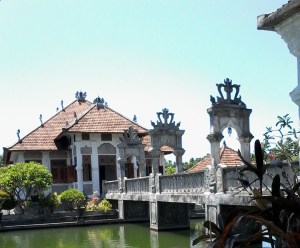
Ujung Water Palace is a beautiful park with big fish pond surrounds the old Karangasem Empire heritage building which is used by the Karangasem’s King for day relaxation or meeting place in their era. It is located in Ujung Countryside about 5 Km from Amlapura town. This park is originally met one pool only which is very Ghostlike and very secret called by Di Dirah and this pool at the period of I Gusti Gede Putu King (1849-1893) governance with his brother of Gede Oka (1849-1890) that the around of this pool is functioned as place of exile for the man who alleged to run the black magic (leak). At the period of I Gusti Bagus Jelantik governance which start to lead the Karangasem Kingdom in the year 1909, this pool area is extended and developed by some pools and also luxury building Bale Gili with European style (modern style), later then it is given the name called Taman Sukasada / Sukasada Park Ujung Karangasem and known as a Ujung Water Palace, that is estimate made in the year of twentieth.

Ujung Water Palace is strategically located in the coastal side, south part of Karangasem town and founding a lot of wellspring around the area. If seen from the history aspect, most of all omissions from Karangasem Empire both for Lombok Island and also exist in Bali, altogether area consisted by the pool and Gili building which is exist in the middle of pool like Mayura and Narmada Park which are existing in west part of Lombok Island.

On the most tip of the highest level of this complex of Ujung Water Palace, we will find a great statue of “warak” (rhinoceros). Beneath the warak there is a Bull statue. From this high place we will see a marvellous view of sea, hills with lush and green forest, the beauty of Mount Agung combined with the green terraced rice fields.

The greatness of Ujung Water Palace had been destructed by the explotion of Mount Agung in 1963 which was made worst by the great shake happened in 1979. However, the recovery effort had been performed to bring back the glory of this complex of water palace by holding a reconstruction and revitalisation project on it. Although it is not as great as it was, the amaze of the past still can be seen here this moment.

We can say that this Ujung Water Palace as a mascot of tourist destinations in east part of Bali because Sukasada Park has been recognized until foreign countries since twenty’s year and more famous again in the year of thirtieth when all foreign tourist start to pay a visit to Bali. King of Karangasem I Gusti Bagus Jelantik who is known as Anak Agung Anglurah Ketut Karangasem is a Statesman, Man of letters as well as an architect. He has created a lot of building not even in the form of park but he also done some building which are exist in Puri Agung Karangasem (Karangasem Palace) like gateway which is looking like pagoda.


Bali Ujung Water Palace Location:

Ujung Water Palace is located in Ujung Countryside lies at Tumbu village, south part of Karangasem regency or about 2, hours from Bali’s International Airport. From Denpasar Town, we have to take the highway of Ida Bagus Matra’s Street and go to the east part of Bali until arrive at Karangasem town. The journey will take about 2 hours and turn right to the south part of Karangasem town. Ujung Water Palace is right located in the costal side with beautiful old building and the right place to visit during your vacation in Bali.

Bali Driver, Bali Driver Seminyak, Sunset Road Bali, Seminyak Activities, Seminyak Driver, Seminyak road, Seminyak Taxi, seminyak tour, Seminyak Tours, Seminyak Transport, thing's to do in seminyak

Seminyak to Ulun Danu Bratan Temple


bratan_lake_temple
Lake Bratan Temple

Ulun Danu Bratan Temple

Seminyak to Ulun Danu Bratan Temple is take us about 2 hour drive, is a temple dedicated to the goddess of the lake – Ida Batari Dewi Ulun Danu on the edge of a huge crater. The dominant shrines are Meru’s, is one of the best place to visit on north Bali and the ticket visiting the Lake Bratan temple is 60.000 IDR per person

Dedicated to the goddess of the lake is Ida Batari Dewi Ulun Danu on the edge of a huge crater. The dominant shrines are Meru’s (pagodas) dedicated to the lake goddess and the gods of Mount Batur and Mount Gunung Agung, the largest volcano in Bali. The temple was built in the 17th century in worship of the main Hindu trinity, Brahma-Vishnu-Shiva, as well as the lake goddess, Dewi Danu. The sight and cool atmosphere of the Bali uplands have made the lake and this temple a favourite sightseeing and recreational spot as well as a frequently photographed site. Ulun Danu Beratan Temple, literally ‘the source temple of Lake Beratan’, is easily the island’s most iconic sanctuary sharing the scenic qualities with the seaside temples of Uluwatu Temple and Tanah Lot. The smooth reflective surface of the lake surrounding most of the temple’s base creates a unique floating impression, while the mountain range of the Bedugul region encircling the lake provides the temple with a scenic backdrop.

Ulun Danu Beratan Temple mostly called as a Ulun Danu Temple but not to be confused with Ulun Danu Batur Temple, which is on the rim of the caldera at Batur Lake. It is especially important for the Balinese. Only here can you get holy water of a particular variety. The water is collected from the lake itself, directly in front of the temple. Visitors have to wear a sash and not go near. Bathing is forbidden. The lake is the ultimate source of water for the rivers and springs that irrigate central Bali. It is therefore of the utmost importance. The temple priests say that the lake is fed by springs located at each of the wind directions. Each of the springs is the origin of water for that particular region of central Bali. So, farmers from North Bali collect their holy water from the northern spring of the lake and so on. Ulun Danu Temple lies by the western banks of Lake Bratan in the Bedugul Highlands at a level of 1239m, is one of the most picturesque and most photographed temples in Bali. Ulun Danu is inside the caldera of the now extinct volcano Gunung Catur. It is one of the main sources of irrigation in the Balinese highlands, and so the temple is dedicated to Dewi Danu, the lake goddess.

History Ulun Danu Beratan Temple

Ulun Danu temple can be traced back to the rise of the Mengwi kingdom. The name of Ulun Danu Beratan Temple is taken from the lake where the temple is built at Beratan Lake. The name of Beratan Lake is inseparable with the Beratan Mount as Deity and Goddess as fertility source, prosperity to keep the prosperity in life and society life. In Papyrus Chronicle of the Mengwi is elaborated by the history of Ulun Danu Beratan Temple founding together with existence of the Mengwi Empire. Therefore its status is pertained with the secondhand of Temple Empire what is usually pertained as Dang Kahyangan. It is the same to the description in papyrus of Usana Bali and Padma Bhuwana, hence Puncak Mangu Temple where the Panyawangan (representative place to worship) is the Ulun Danu Beratan Temple. So it is called by entire Balinese residents as Kahyangan Jagat (The Biggest Group of Hindu Temple in Bali )

The ‘floating’ temple complex is comprised of four groups of shrines, including the prominent Lingga Petak shrine to its east. There are four gates facing each of the four points of the compass.

Ulun Danu Beratan Temple is consisted of 4 temples complex that are:

  • Lingga Petak Temple owns the function to worship the Siwa God
  • Penataran Pucak Mangu Temple is referred this gate as Parhyangan ri pinggiring rawa Beratan or Danu Beratan Temple is founded by I Gusti Agung Putu to worship the Hyang ing Parwata or Deity which is placed in Pucak Mangu that is Bhatara Hyang Danawa as according to papyrus of Padma Bhuwana and Usana Bali, because Mangu Mount is located in north direction, hence it is called the Bhatara Hyang Danawa or Wisnu God
  • Terate Bang Temple is functioning to worship of Brahma God
  • Dalem Purwa Temple is functioning to worship of Danu Goddess which is considered to be miraculous of the Bhatara Hyang Danawa or Laksmi Goddess.

Ulun Danu Beratan Temple Ceremony

The temple ceremony execution at Ulun Danu Beratan Temple is consisted of two types those are:

  • The temple ceremony which is executed every six-month (210 days) that on Anggara (Tuesday) Kliwon Julungwangi (Base on Balinese Hindu calendar). Every 12 months (420 days) is executed by the bigger ceremony from the ordinary ceremony, so-called Piodalan Agung
  • Pakelem ceremony is executed at any times as according to situation and condition. The Pakelem ceremony owns the function to worship the supremacy and also cheapness of the infinite for award of life, fertility, prosperity, as impact of the existence of ecosystem balance so that give the benefit for life and universe life forever and ever, during Beratan Lake and Beratan Mount stand up
Bali Driver, Bali Driver Seminyak, Sunset Road Bali, Bali temple, Batuan Temple, Seminyak Activities, Seminyak Driver, Seminyak road, Seminyak Taxi, Seminyak to Batuan Temple, seminyak tour, Seminyak Tours, Seminyak Transport, thing's to do in seminyak, transport to batuan temple

Seminyak to Batuan Temple


Batuan Temple
Batuan Temple

Seminyak to Batuan Temple will take you about 1 hours and 15 minutes drive is a local Balinese Hindu temple looked after by the local resident of Batuan countryside. The temple is designed very beautiful with full of Balinese ornaments and the roof temple building is made from the fiber of chromatic black palm tree.

It is strategically located beside of the main road from Denpasar to Ubud. For over a thousand years, Batuan has been a village of artists and craftsmen, old legends and mysterious tales.


Batuan Temple were founded in the year 944 isaka (1020 AD). Nearly 1000 years old.The Batuan Temple is a Puseh Temple category based on the concept of “Tri Kahyangan or Tri Murti” taught by Mpu Kuturan around the 10th century to the Balinese Hindu community at the time.
Tri Kahyangan or Tri Murti including 3 temples :

  • Desa or Village Temple as a place to worship of God Brahma (the Creator)
  • Puseh Temple  to worship of God Vishnu (the Preserver)
  • Dalem Temple  to worship of Lord Shiva (the Destroyer)

History of Batuan Temple 

The name “Batuan” or “Baturan” mentioned here prompts villagers to joke about being “tough as stone” or “eating rocks” as batu means “stone” in Balinese. But it likely refers to an ancient megalithic tradition in which standing stones served as meeting places and ceremonial sites for the worship of ancestral spirits. Because Batuan became a center from which Buddhist priests and brahmans spread to the main court centers of south Bali, the village has an unusual preponderance of brahman.

Local people are very concern about the care and preservation of the temple architecture and its environment. Not all existing buildings were old buildings here, there are some that have undergone renovation, renewal, and change from 10th century to 13th century and also 18th century AD. The structure and foundation of this temple are very tough and strong. It has the original Balinese ornament that beautifully craved on every building at this temple area. Some ornaments are reflection of The Ramayana Epic story and every holy building has different function philosophically.

Batuan Temple Area Consist Of : 

At temple parking area, there is standing an ancient building called Wantilan, this place use as a meeting hall and to practice any kind of Balinese dances as Gambuh Dance, Pendet Dance, etc. Before you enter the temple there is some local people at Wantilan will lend you ‘kamben’ (a traditional Balinese costume). It is a must for you to wear ‘Balinese kamben’ to show your respect and honor about the holiness of “Puseh Temple of Batuan Village”. It’s all free, you won’t be charged for entrance. However, the local people expect every tourist who visited to this temple can donate in any amount of money to support the maintenance of the temple. There is provided a simple donation box. Every donation that you give should be based on a sense of sincerity, where Balinese people know it is called “medana punia”.

In the middle yard of temple there is a long building / bale called the Bale Agung and Bale Kulkul (a gong mad by wood or bamboo).In this yard there is also a high entrance Balinese Gate called the Kori Agung, which is flanked by the many guardian statues shaped the giant sculpture. The function of Kori Agung is the door where the exit and entry for the gods symbolized by a small statue called Pratima. Next to the Kori Agung  there are two small doors as a place of exit and entry of people into the temple’s main yard.

In the main yard of the temple there are some three story Meru and Bale Pengiyasan as a symbol of the temple of Besakih, there is also a building called Padmasana as a place of worship to Sang Hyang Widhi, the only one Bali Hindu’s God.

Batuan Temple is not only emitting a high spiritual vibration, but also representing the historical values. You can look inside there are many stunning ancient relics from prehistoric times. How the influence of Hindu culture in Bali made of natural stones in this temple become a place of worship, both to their ancestors and worshiped Hindu Deities. You will amaze in finding some ancient and unique statues there. Based on a number of statues found in this Puseh Temple, it can be grouped into several types. They are Dwarapala Statue, Embodiment Statue, Animal Statues, The Status Figure of Holding the Chicken, Phallus, Demons (Time), and many more.

Bali Driver, Bali Driver Seminyak, Sunset Road Bali, Seminyak Activities, Seminyak Driver, Seminyak road, Seminyak Taxi, seminyak tour, Seminyak Tours, Seminyak Transport, thing's to do in seminyak

Seminyak to Tirta Empul Temple


Tirta Empul
Tirta Empul

Seminyak to Tirta Empul Temple is taking about 1 Hour 45 Minutes drive is built around the sacred spring at Tampak Siring. For more than a thousand years, Balinese worshipers have been drawn to Tirta Empul Temple whose sacred spring is said to have been created by Indra and to have curative properties. The tradition continues almost unchanged at the temple today.Over 1000 years old, the temple and its two bathing places have been used by the people for good health and prosperity because of the spring water’s curative powers. The ticket visiting Torta Empul Temple is 15.000 IDR per person


History Of Tirta Empul Temple : 

Tirta Empul Temple It is a myth described on a manuscript called Usana Bali says that a Balinese arrogant king named Maya Denawa did not believe in god, and objected the people to worship god. Later the punishment for the king came. The warior of Bhatara Indra arrived to attack Maya Denawa and put him away from the throne. But Maya Denawa used chemical weapons causing all the warriors of Bhatara Indra were poisoned to dead. Seeing this Bhatara Indra than planted his pole to the earth, and sprang water. This water was used to spray the dead warriors, and they alive back. So this water source until now is believed to be the source of life and prosperity. It is especially correct if we associate this water spring with the irrigation system around the area, as it gives hundreds of hectares of rice field from Tampaksiring until Pejeng areas.

The inscription mentions the construction of Tirta Empul Temple in 960 AD, when the king Chandrabhaya Singha Warmadewa ordered this which is already 1042 years ago. It seems that this place was not interesting for ancient king but on 1954 the first Indonesian president Soekarno had built his presidential villas just at the west side of the temple. Originally a residence for Dutch officials, it was later used by former President Soekarno during his frequent trips to Bali. This villa has brought also the name of Tampaksiring become known world widely.

The present temple as a common temple of Bali, the layout is divided into 3 courtyards. At the middle courtyard is constructed and first courtyards were constructed:

  • Pool with 13 fountains, used as holy water for cremation or dead ceremony,
  • Pool with 8 fountains, used as water for symbolic cleaning ( spiritual purification ), when a person is sick it is believed he is infected by immaterial dirt.
  • Pool with 5 fountains for holy water used people from outside come to pray.

At the first courtyard is also a pool for public bathing place. Total number of shrines at Tirta Empul Temple are 30 nits currently, after later addition by local people who have the responsibility for the temple. The ceremony is performed every 210 days, and fixed date can be read in Balinese calendar.

There is an old stone sculpture being preserved at the last courtyard of the Tirta Empul Temple in the form of buffalo. The condition of the carving is badly damage, so it can’t be observed in detail to fix the type. Buffalo in the pantheon of Hindu is considered as the mount of god Shiwa and this animal is called ” Nandi

The name “Tirta Empul” signifies a crystal clear stream which is used as the holy water for various religious ceremony. Visitors are allowed only up to the main courtyard. From here, one could enjoy the twin shrines and split gate, common in most temples in Bali. Inside the inner sanctum, there are a number of bathing pools for the Hindus.

The Tirta Empul Temple includes the traditional Balinese split gate along with shrines to Shiva, Vishnu, Braham, Mt. Batur, and Indra. There is also a large open pavilion in the main courtyard, useful for relaxing in the shade.

But the main attraction at Tirta Empul Temple is a long rectangular pool carved of stone, filled with koi and fed by the sacred spring via 12 fountains. Worshippers first make an offering at the temple, then climb into the main pool to bathe and pray. Many collect the holy water in bottles to take home. Nearby there are two smaller pools fed by the spring.

Tirta Empul Temple is located in the village of Tampak Siring, accessible by public transportation from Ubud. The souvenir stands outside the temple specialize in the local craft, carved bone jewelry.

Bali Driver, Bali Driver Seminyak, Sunset Road Bali, Seminyak Activities, Seminyak Driver, Seminyak road, Seminyak Taxi, seminyak tour, Seminyak Tours, Seminyak Transport, thing's to do in seminyak

seminyak to tegalalang rice terrace


Bali_rice_terrace_ubud
Bali_Rice_terrace

Seminyak to Tegalalang Rice Terrace located on the north side of Ubud around 20 minutes drive. This area is famous tourist attraction for beautiful rice terraces, many tourists who travel to and from Kintamani stopped at this place to witness the beauty of the verdant terraced rice field scenery or having lunch at the restaurant while enjoying the beautiful scenery of terraced rice fields. Tegalalang Rice Terrace is one of the tourist icon in Ubud Bali.

The rice terrace is designed very beautiful with exquisite hollowing rice field and precisely located on the hill bank. In this place, you will see the Balinese farmer do their rice field in oblique area complete with its system irrigation. You will enjoy the beautiful panorama of valley with rice terrace and coconut trees ornament it.

The northern part of Ubud, there is one area called Tegalalang, where many great home industries. Hundreds of miscellaneous crafts of cat and mouse, dolphin, giraffe, etc. that are made of wood or iron were manufactured here.  Other handicrafts produced are bags of different models from a variety of materials, stone carvings, cheap wooden carvings, wooden masks, all sorts of glass handicrafts is formed into a vase, unique bottles or plates. Everything is here. Shop and showroom is lined up along the 10 km, if we’re shopping here, of course depends on how thick is your pocket.  It’s endless.